


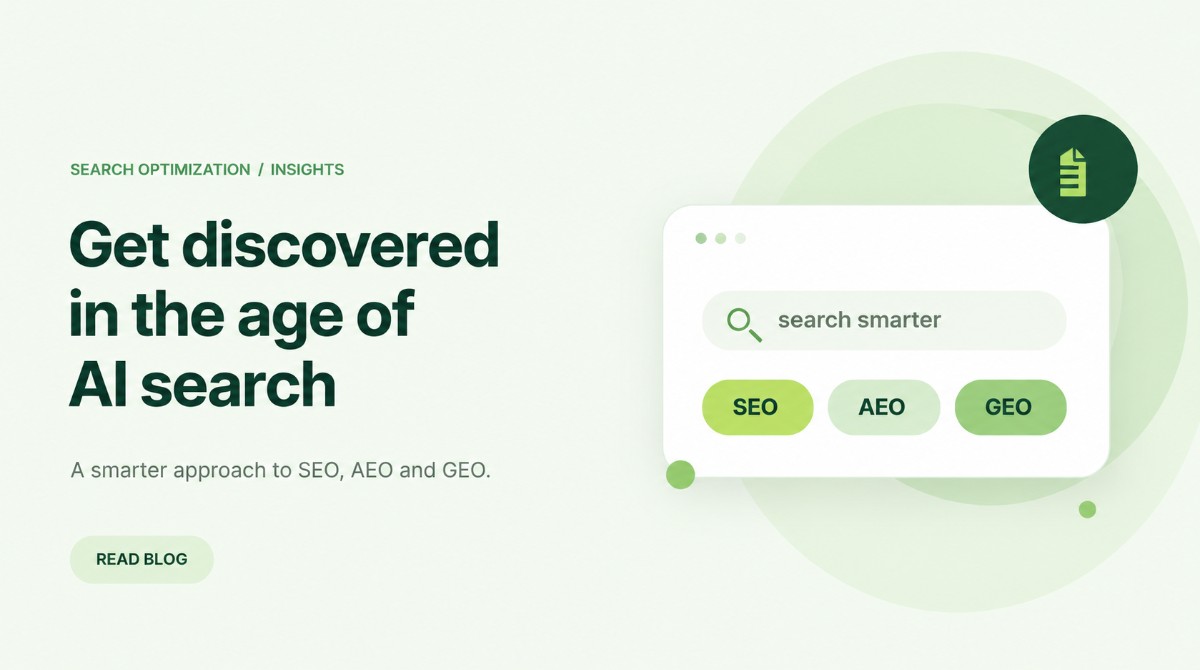
People still search using familiar results pages, but they may also ask questions through AI-powered tools and answer experiences. For businesses, this creates a practical question: how should a website prepare? Understanding SEO, AEO and GEO can help you build a more useful search presence without chasing every new trend.
The most important principle has not changed. Your website should answer real questions clearly, work well on different devices and make it easy to understand who stands behind the information.
What is the difference between SEO, AEO and GEO?
Search engine optimization (SEO) helps search engines discover, understand and present relevant pages. It includes site structure, useful content, internal links, page performance and technical access.
Answer engine optimization (AEO) focuses on making direct answers easy to find and understand. Clear headings, concise explanations and helpful context can support people looking for quick answers across different interfaces.
Generative engine optimization (GEO) is a developing term for improving a brand's discoverability and representation in AI-generated answers. There is no universal method that guarantees inclusion or citation. Accurate, useful, well-supported information is a sensible foundation.
These ideas overlap. A strong SEO foundation supports both traditional discovery and newer search experiences, even though different products may surface information in different ways.
Begin with the questions customers actually ask
Keyword research remains useful, but it is more than collecting phrases with large search volumes. Start with the needs behind each question. A visitor searching “how to choose product packaging” wants education; someone searching “packaging design agency” may be comparing service providers.
Group related questions by intent. Map each group to the most relevant existing page or a new article. Avoid writing many near-identical blogs for tiny keyword variations. One clear guide that thoroughly solves a problem is usually more useful than a collection of thin pages.
Make each page easy to scan and understand
Use one descriptive main heading, informative subheadings and short paragraphs. Explain technical terms in plain English before using abbreviations. Give the direct answer near the relevant question, then add examples, limitations and useful next steps.
Your title and meta description should represent what the page actually covers. A well-written description can help readers decide whether to visit, although search engines may create their own snippets. Use relevant terms naturally; repeating a keyword in every paragraph does not make content more helpful.
Strengthen your technical SEO foundations
Even excellent writing can be difficult to discover if the website has serious technical problems. Check whether important pages can be crawled and indexed. Review canonical tags, redirects, mobile usability, navigation, broken links and XML sitemaps where appropriate. Use internal links to show how related pages connect.
Page speed also affects the user experience. Compress large images, limit unnecessary scripts and test important page templates. Structured data can help eligible content communicate meaning to search engines, but adding markup does not guarantee a special search appearance. Follow each search engine's documentation rather than relying on shortcuts.
Build trust with specific, accurate information
When making claims, show how you know. Use named authors where appropriate, real examples, clear dates and trustworthy sources. Explain the limits of a recommendation, especially when advice depends on an industry, audience or budget.
For a service website, clear contact details, relevant portfolio work and specific descriptions of the team or process can make information more useful. Never invent client achievements or data. If content was prepared with AI assistance, review it carefully for accuracy, originality and a genuinely helpful point of view.
Think beyond the individual blog post
A blog works best as part of a connected website. Link educational articles to service pages when the relationship is useful. For example, an article about search visibility can lead readers to a technical audit or SEO service page. Related articles should help visitors explore a subject, not force them into a sales funnel.
Monitor search queries, indexing, engagement and useful actions through available analytics tools. AI-driven referrals may be difficult to measure consistently, so do not treat one dashboard as the complete picture. Review content regularly when products, practices or information change.
Frequently asked questions
Does GEO replace traditional SEO?
No. GEO is a newer label for visibility in generative experiences. Clear, credible content and accessible websites remain important foundations, while no method can guarantee AI citations.
How long does SEO take to work?
It varies by competition, site history, resources and the changes required. Technical corrections can be visible relatively quickly, while lasting organic growth often requires sustained improvement and review.
Make your expertise easier to discover
A practical approach combines technical SEO, useful answers and trustworthy information. Learn about Poppy Seed's SEO, AEO and GEO services to plan improvements for traditional and AI-assisted search journeys.